
“Why Collaboration Fails and What Ecosystem Thinking Can Do About It” - A webinar for those working to drive social impact
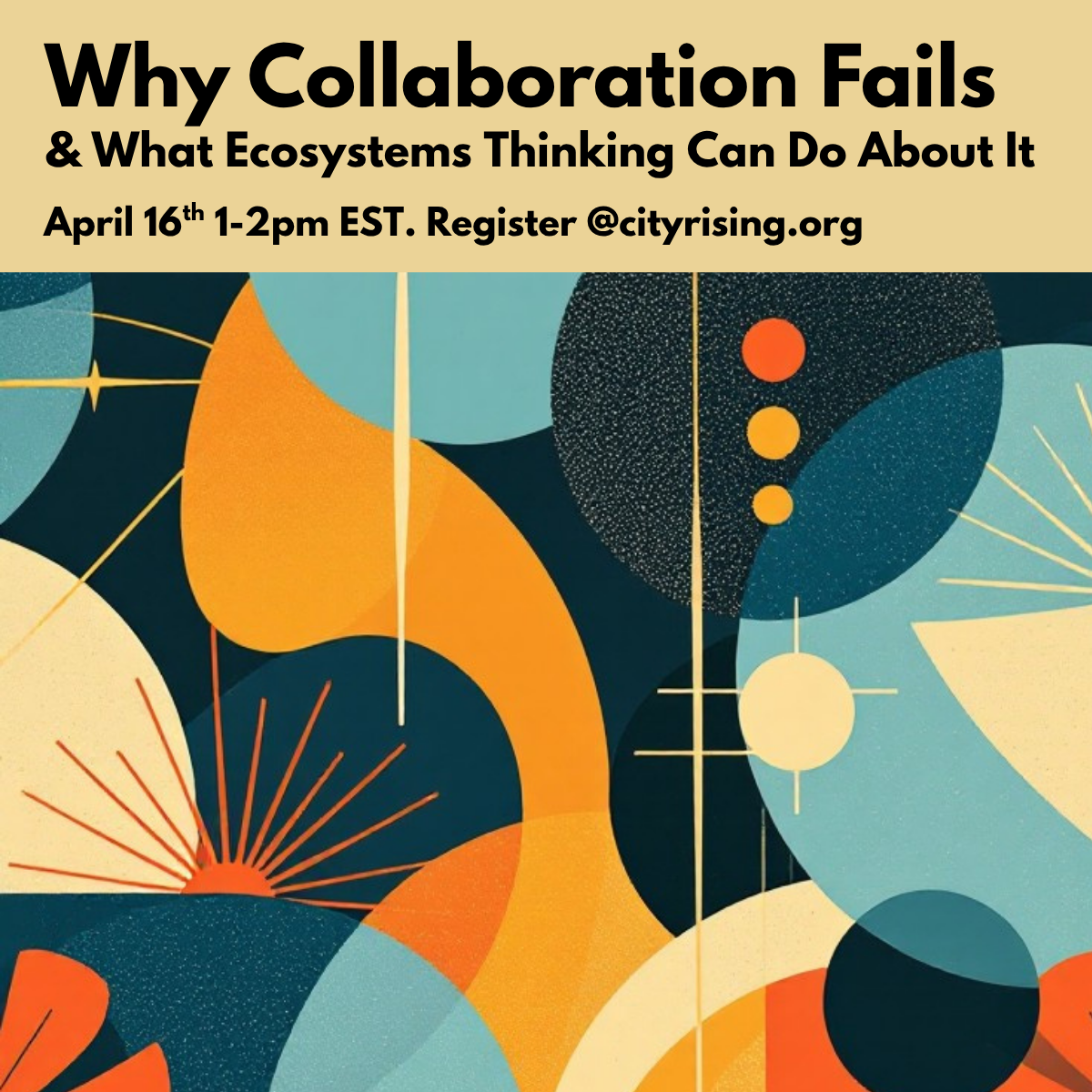
Join us April 16 from 1-2pm EST for a discussion on Why Collaborations Fail.
Collaboration has become a default strategy in social impact work. Organizations are asked—often required—to partner, align, and coordinate. And to be clear, collaboration brings real strengths: it can build resilience, connect fragmented efforts, and help communities respond more effectively to complex challenges.
But collaboration alone isn’t enough.
Many collaborative efforts fail—not because the people involved lack commitment or skill, but because they are operating from a limited frame. When collaboration is built on a siloed or program-centered perspective, it often focuses too narrowly on individual organizational goals, isolated metrics, or short-term outputs. The result is coordination without meaningful change.
This is where an ecosystems shift becomes critical.
An ecosystems perspective expands the field of view. Instead of focusing only on organizations and programs, it asks: how do actors, flows, structures, narratives, and relationships interact to shape outcomes? It makes visible the conditions that either support or constrain impact—how resources move (or don’t), how decisions are influenced, how issues are framed, and how relationships enable or limit what’s possible.
When collaboration is grounded in this broader understanding, it becomes more than coordination. It becomes strategic.
Ecosystems thinking allows organizations to:
Identify leverage points beyond their immediate scope
Align efforts without duplicating or competing for the same outcomes
Adapt to changing political, cultural, and funding environments
Strengthen sustainability by working with—not against—the system
In contrast, siloed approaches often require increasing resources just to maintain the same level of impact. Ecosystems approaches, when done well, create the conditions for impact to compound.
This is the focus of City Rising’s kickoff session in the Social Impact Learning Series: Why Collaboration Fails — and What Ecosystem Thinking Can Do About It. In this webinar, we’ll break down where collaboration breaks down, introduce a practical ecosystems framework, and offer tools you can begin using immediately to strengthen your work.
If your collaborations feel stuck—or if you know they could be doing more—this session will give you a clearer way forward.
Join us April 16 from 1-2pm EST for a discussion on Why Collaborations Fail.